Solid Perfume Box Closure Types: A Specifier's Guide
深圳市协兴工艺品有限公司
Contents
!Solid Perfume Box Closure Types: A Specifier's Guide
When brands approach us to develop a custom metal perfume or balm container, the conversation usually starts with aesthetics — enamel colors, finishes, logo placement. But one of the first technical decisions that determines both user experience and tooling cost is the solid perfume box closure. Get this wrong, and you may face expensive mold revisions, leaky samples, or a lid that feels cheap in hand. In this guide, we break down the main perfume tin lid types — slip lid, threaded, hinged, and press-fit — so you can specify with confidence before committing to tooling.
Why Closure Choice Matters Before Tooling
!Solid Perfume Box Closure Types: A Specifier's Guide
A closure is not just a cap. It defines how the product opens, how it seals, how it survives transit, and how the consumer interacts with the contents every day. For solid perfume and balm products specifically, the closure also affects whether the formula stays protected from air and moisture over time.
From a manufacturing standpoint, each closure type requires different tooling — different molds, different assembly steps, different tolerance bands. If you change your mind mid-sampling, the cost of re-tooling can set your project back by weeks. That is why we encourage specifiers to evaluate closure trade-offs early, ideally during the initial design brief.
We have seen projects where a brand initially requested a threaded lid for a premium feel, then switched to a slip lid after sampling because the target demographic preferred quicker, one-handed access. The switch was manageable because it was caught early. Had it happened after bulk production tooling was locked, the financial impact would have been significant.
Common Perfume Tin Lid Types Explained
Let us walk through the four closure categories we most frequently produce for solid perfume and balm containers. Each has distinct tooling implications and user-experience characteristics.
Slip Lid (Friction Fit)
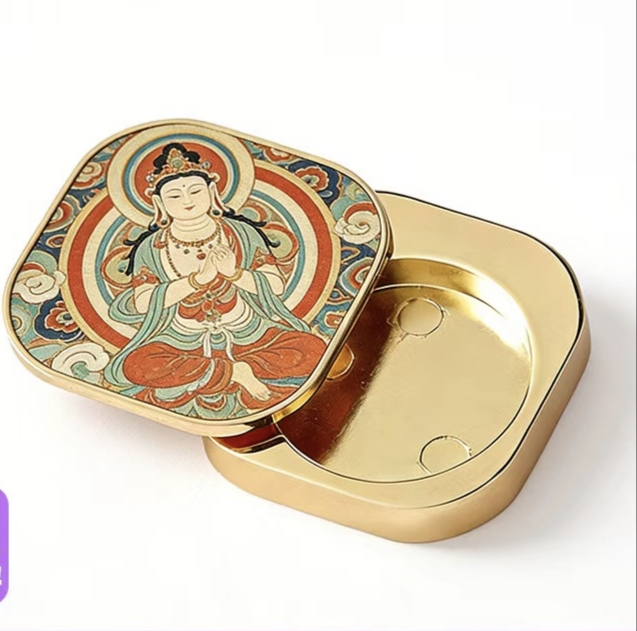
The slip lid is the simplest closure: the lid slides over the base and stays in place through friction. No threads, no hinges, no locking mechanism — just a precise interference fit between two metal parts.
Pros:
- Lowest tooling complexity and cost
- Fast to assemble in production
- Clean, minimalist aesthetic
- Easy for consumers to open
Cons:
- Seal is not airtight — fine for firm balms but less ideal for softer formulations
- Friction can loosen over repeated use if tolerances drift
- Not ideal for air freight where pressure changes may pop the lid
Slip lids work well for everyday lip balm tins and solid fragrances where the formula is firm enough that a perfect air seal is not critical.
Threaded Lid (Screw-On)
A threaded closure uses helical threads on both the lid and the base that interlock when twisted. This is the most secure common closure type for metal tins.
Pros:
- Superior seal against air and moisture
- Consumer perception of quality and precision
- Tamper-evident potential
- Reliable over hundreds of open-close cycles
Cons:
- Higher tooling cost — threads require precise CNC-machined molds
- Slightly slower assembly in production
- Typically requires two hands to open
When the threaded vs slip lid debate comes up in a spec meeting, the deciding factors are usually formulation softness and price positioning. If your product contains a softer balm or you are positioning at a luxury tier, threaded usually wins. The tactile experience of unscrewing a metal lid communicates craftsmanship.
Hinged / Flip Lid
A hinged lid is permanently attached to the base through a mechanical hinge — either an integral metal hinge formed during stamping or a separate pin-and-knuckle assembly.
Pros:
- Lid never gets lost — ideal for portable, on-the-go products
- Fast, one-handed opening
- Strong consumer convenience factor
- Can incorporate a mirror inside the lid
Cons:
- Most complex tooling of the four types
- Hinge durability is a critical QC point
- Slightly higher per-unit cost
Hinged closures are increasingly popular for wearable formats. Our hanging solid balm box with necklace pendant uses a hinged design specifically because the product is worn and opened frequently throughout the day — losing the lid is not an option.
Press-Fit (Snap Closure)
A press-fit lid uses a designed detent or bead that snaps into a corresponding groove on the base. It provides a tactile click that confirms the lid is secured.
Pros:
- Audible and tactile feedback — satisfying user experience
- Better retention than a plain slip lid
- Moderate tooling complexity — less than threaded, more than slip
- Good seal quality for most solid formulations
Cons:
- Requires tight tolerance control to maintain consistent snap feel
- Snap force can vary with temperature and material batch
- Less common in very small diameter tins (under 20 mm)
Press-fit closures sit between slip and threaded in both performance and cost. They are a solid middle-ground choice when you want better security than a slip lid without the full tooling investment of threads.
Closure Type Comparison Table
| Closure Type | Seal Quality | Tooling Cost | Assembly Speed | User Experience | Best For |
|---|---|---|---|---|---|
| Slip Lid | Low | Low | Fast | Simple, quick open | Firm balms, everyday lip tins |
| Threaded | High | High | Moderate | Premium, secure feel | Luxury solid perfume, soft balms |
| Hinged / Flip | Medium-High | Highest | Moderate | Convenient, one-handed | Travel, wearable pendants, mirror compacts |
| Press-Fit (Snap) | Medium | Medium | Fast | Tactile click feedback | Mid-range balms, gift sets |
This table is designed as a quick-reference block you can share with your product team during the specification phase. Print it, pin it, and use it to align stakeholders before the mold-cutting begins.
Matching Closure to Product Format
The closure decision should never happen in isolation — it depends on the product format, the target user, and the distribution channel.
For a round solid perfume compact intended for retail shelves, a threaded or press-fit lid provides the security and premium feel that justifies the price point. For a custom logo solid perfume container aimed at private-label brands, the closure choice also affects how the product performs in shipping — a loose slip lid may pop open under pressure during air freight.
Wearable formats like necklace pendants almost always call for hinged lids because the consumer cannot afford to lose a lid while wearing the product. Similarly, multi-use containers that hold lip balm, cheek blush, or solid fragrance benefit from hinged designs with integrated mirrors.
If you are sourcing a multi-use metal tin for lip balm and cheek blush, consider how the consumer will handle the product daily. If it lives in a purse and gets opened multiple times a day, a hinged or press-fit lid will outperform a slip lid in long-term satisfaction.
Tooling and Sampling Considerations
At our Shenzhen facility, we approach closure development as part of the overall mold strategy. Here is what specifiers should know before locking in a decision:
- Threaded molds require dedicated CNC tooling. The thread profile must be cut to tight tolerances (typically ±0.05 mm), and the mold cost reflects that precision. This is non-negotiable — a poorly cut thread will cross-thread or jam.
- Hinged designs require hinge-pin tooling and assembly fixtures. The hinge is often the weakest point, so we run cycle tests during sampling to validate durability before bulk production.
- Slip and press-fit lids share similar base tooling. The difference is whether the mold includes a detent groove. Upgrading from slip to press-fit mid-project is usually feasible without a full mold rebuild — one of the few late-stage changes that will not blow your budget.
- Sampling takes as fast as 3 days for standard closure types. Complex hinged mechanisms or unusual shapes may require additional iterations.
We provide free samples before bulk production so you can physically test the closure feel — the snap, the screw resistance, the hinge action — before committing. This is the single most effective way to prevent spec errors.
Common Specification Mistakes to Avoid
Over our 15 years of producing metal containers and cultural creative gifts, we have seen a few recurring mistakes that are entirely avoidable:
- Specifying a closure based on appearance alone. A lid that looks great in a 3D render may feel wrong in hand. Always request a physical sample.
- Ignoring transit conditions. Slip lids can open under pressure changes during air shipping. If your product ships globally, test this with a packed sample.
- Underestimating hinge wear. For hinged designs, request cycle testing data. A hinge that fails after 200 opens is a warranty risk and a brand reputation problem.
- Mixing closure types across a product line without reason. Consistency helps brand recognition. If you use threaded lids for your core line, switching to slip for a variant should be a deliberate, documented choice — not an oversight.
For a broader look at how solid perfume packaging fits into brand strategy, our article on solid perfume boxes as premium packaging solutions covers material choices, finishes, and positioning beyond just the closure.
Our Manufacturing Capabilities
Shenzhen Xiexing Gift Co., Ltd has been manufacturing custom metal containers and cultural creative gifts since 2011. Our 6,000 m² facility in Shenzhen's Pingshan District runs the full production pipeline — from design and mold development to stamping, enamel filling, assembly, and quality inspection.
We support all four closure types discussed above and can advise on which best fits your product format, budget, and timeline. With a minimum order of 500 units for solid perfume containers, free design support, and sampling in as fast as 3 days, we help brands move from concept to shelf-ready product without unnecessary friction.
Our certifications include ISO9001 and SEDEX 4P, and our 20 years of export experience mean we understand the regulatory and logistical requirements of shipping to over 30 countries. We have served Fortune 500 companies, more than 20 national museums, and institutions like the 2008 Olympics and 2010 World Expo.
If you are also planning giveaway or promotional products alongside your perfume line, our guide on trade show giveaway strategy and ROI can help you align packaging decisions with broader campaign goals.
Actionable Takeaway
Before you finalize your spec sheet, do three things: (1) match the closure type to your formulation hardness and consumer use pattern, (2) request a physical sample to test the closure feel in hand, and (3) confirm transit testing if your product ships by air. These three steps will catch the vast majority of closure-related spec errors before tooling is locked — saving you time, money, and a lot of frustration down the line.
To discuss your project specifics — including closure recommendations based on your product format — reach our team at 0755-84851470 or sales@xiexingift.com. We respond to design and tooling inquiries within one business day.
Share this entry
Further Reading
Solid Perfume Box Closure Types: A Specifier's Guide !Solid Perfume Box Closure Types: A Specifier's Guide When brands approach us to develop a custom metal perfume or balm container, the conversation usually starts with aesthetics — enamel colors, finishes, logo placement. But one of the first technical decisions that determines both user experience and tooling cost is the solid perfume box closure. Get this wrong, and you may face expensive mold revisions, leaky samples, or
_1784103745596.webp)

_1784103723073.webp)